








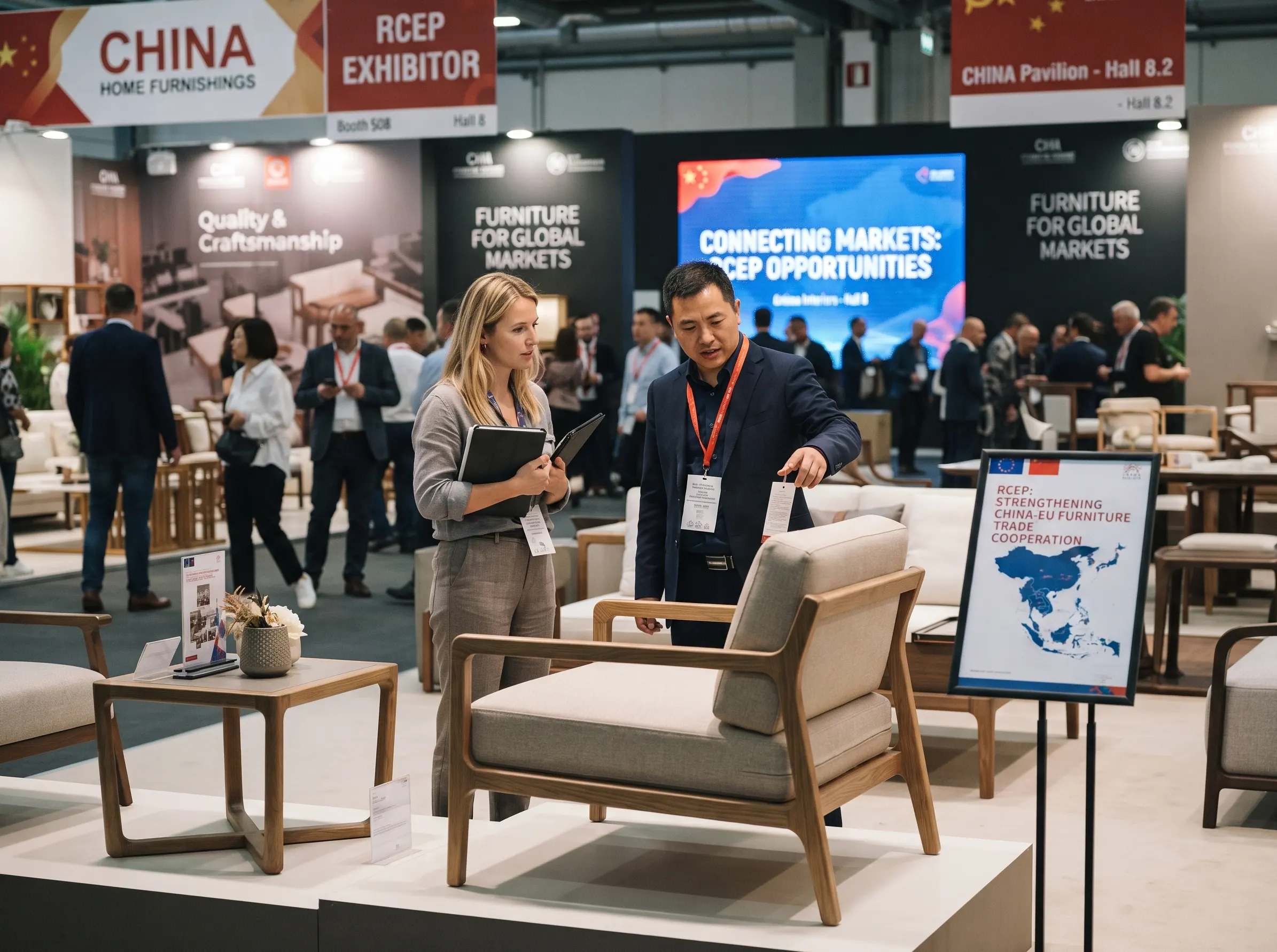
RCEP furniture trade is experiencing structural acceleration across the Asia Pacific. The Regional Comprehensive Economic Partnership’s tariff reduction schedules and origin cumulation rules are collectively driving Chinese furniture export growth rates in ASEAN, Japan, South Korea, and Oceania beyond traditional Western markets. However, the widely marketed “zero tariff” narrative misrepresents reality. Most furniture categories follow phased reduction timelines stretching to 2030 or later, and the greatest beneficiaries are not finished goods exporters but Chinese component manufacturers supplying ASEAN assembly operations. Understanding the actual mechanics of origin rules and tariff phase-ins separates informed buyers from those chasing headlines.
What RCEP Actually Does for Furniture (And What It Doesn’t)
The Tariff Reduction Timeline: A Gradual Unfolding, Not a Big Bang
RCEP does not flip a switch. The agreement structures tariff elimination across multiple tracks, with different member states committing to different phase-in periods depending on product classification and their existing tariff levels. For furniture and furniture parts classified under HS Chapters 94 and related component headings, the reality on the ground is a staggered schedule rather than immediate duty-free access.
China’s tariff commitments to ASEAN partners on many finished wooden furniture items began with modest reductions from baseline rates of 5% to 20%, with full elimination scheduled for 2028 to 2032 depending on the specific HS code. Metal furniture and upholstered seating often sit on longer timelines. Japan’s tariff elimination schedule for Chinese furniture imports similarly spreads across twenty-year trajectories for certain categories, though many lines saw steeper initial cuts. Industry observers tracking Guangdong export patterns note that tariff schedules vary significantly by HS code and country pair, with many furniture lines still subject to phased reduction rather than immediate zero rates. Importers should verify the exact status of their specific product classifications against current official schedules.
The implication is direct. Buyers calculating landed costs must request the specific HS code classification from their suppliers and cross-reference the applicable RCEP tariff reduction table for the importing country. A sofa shipped from Foshan to Bangkok in 2026 may face a different effective duty rate than an identical sofa shipped to Osaka. Generalizing about “RCEP zero tariffs” without checking the specific product-country-year matrix leads to budget surprises.
The Origin Cumulation Rule: The Real Game-Changer
If tariff reductions are the visible headline, origin cumulation is the operational engine reshaping supply chains. RCEP introduces regional cumulation across all fifteen member states, meaning materials sourced from any RCEP country can count toward the originating status of finished goods produced within the bloc. This rule fundamentally alters how furniture manufacturers configure their production networks.
A Vietnamese factory assembling dining chairs can use Chinese-origin timber, Japanese hardware, and South Korean upholstery textiles while still qualifying the finished product as RCEP-originating. The 40% regional value content threshold—or the applicable product-specific rule—can be met by aggregating value added across multiple member states rather than concentrating it in one. This provision explains why Chinese furniture component exports to ASEAN have outpaced finished furniture export growth since RCEP’s entry into force. For reference only, subject to official verification, industry observations from Guangdong and Zhejiang indicate that component export value growth to ASEAN has outpaced finished furniture growth since RCEP implementation, reflecting supply chain restructuring rather than finished goods displacement.
For buyers, this means the “Made in Vietnam” label on a chair no longer signals exclusion from RCEP benefits if that chair’s supply chain is woven through RCEP territories. For Chinese suppliers, it creates an incentive to specialize in high-value components—hardware systems, engineered panels, soft体 mechanisms—rather than competing solely on finished goods assembly.
RCEP vs. Existing Bilateral Deals: Where the Overlaps and Gaps Live
RCEP did not arrive into a vacuum. China already maintained bilateral free trade agreements with all RCEP members except Japan prior to 2022. Australia and New Zealand operated under long-standing bilateral FTAs with China. ASEAN and China had their own Comprehensive Economic Cooperation Agreement. This layering creates a complex environment where RCEP sometimes offers better terms, sometimes duplicates existing benefits, and occasionally introduces stricter rules of origin than bilateral alternatives.
| Agreement | Coverage Scope | Origin Threshold | Key Furniture Advantage |
|---|---|---|---|
| RCEP | 15 members, regional cumulation | 40% RVC or PSR | Regional supply chain flexibility |
| China-ASEAN FTA | 10 ASEAN states | 40% RVC | Simpler documentation for direct China-ASEAN trade |
| China-Australia FTA | Australia only | Various product-specific | Broader tariff elimination on certain metal furniture lines |
| China-NZ FTA | New Zealand only | 40% RVC or CTH | Established certificate procedures |
| China-South Korea FTA | South Korea only | 40% RVC or PSR | Faster phase-in on some upholstered items |
The critical distinction lies in origin flexibility. A Chinese manufacturer exporting finished beds to Australia may find the bilateral China-Australia FTA offers identical or superior tariff outcomes with simpler compliance requirements. However, that same manufacturer selling bed frames to a Thai assembler who then exports finished products to Japan cannot use the bilateral China-Japan framework because it does not exist—RCEP is the only mechanism providing that triangular coverage. Buyers sourcing across multiple Asia Pacific markets increasingly prefer RCEP precisely because it standardizes documentation and enables multi-country sourcing strategies that bilateral agreements cannot accommodate.
Which Asia Pacific Markets Are Buying More Chinese Furniture
ASEAN: From Competitor to China’s Largest Regional Customer
The narrative of Vietnam and Thailand as pure competitors to Chinese furniture exports is outdated. Since RCEP implementation, ASEAN nations have emerged as the fastest-growing destination region for Chinese furniture shipments, with import volumes expanding significantly year-over-year. Chinese furniture and component exports to Vietnam have expanded substantially since RCEP implementation, with cross-border trade flows intensifying as Vietnamese manufacturers increase sourcing of Chinese materials for regional assembly operations. Similar demand patterns are visible in Thailand and Malaysia, though exact growth rates vary by product category and are difficult to isolate from broader trade statistics.
This demand surge is bifurcated. On one side, ASEAN’s domestic consumer markets are expanding. Urban middle-class growth in Jakarta, Bangkok, and Ho Chi Minh City drives demand for affordable modern furniture that Chinese factories in Foshan and Dongguan can produce at scale. On the other side, ASEAN manufacturers themselves are importing Chinese components, parts, and semi-finished materials to feed their own export-oriented assembly operations. The competitor-customer duality is real. A Vietnamese exporter of wooden bedroom sets to the United States may still import the majority of its hardware, lacquer, and panel materials from China, leveraging RCEP cumulation to maintain origin eligibility for its own finished exports.
Buyers operating retail chains in Kuala Lumpur or Manila should recognize that their Chinese suppliers are now simultaneously serving them and their domestic manufacturing competitors. Pricing power and supply priority are shifting accordingly.
Japan and South Korea: High-End Demand Unlocked by Lower Tariffs
Japan maintained relatively high tariff walls on many furniture categories prior to RCEP, with duties on wooden furniture and upholstered seating creating friction that suppressed full market access for Chinese producers. RCEP’s gradual tariff dismantling has altered the calculus. Japanese hospitality developers, hotel operators, and residential real estate firms are increasingly sourcing custom furniture from Guangdong and Zhejiang clusters as duty costs compress.
The psychological barrier matters as much as the tariff line. Japanese consumer acceptance of Chinese-made furniture has historically lagged behind industrial buyers. RCEP’s formalization of trade terms, combined with visible tariff reductions, has provided cover for procurement managers to shift sourcing volumes without internal organizational resistance. Japanese procurement managers in the hospitality and commercial sectors report increasing willingness to source directly from China for select furniture categories as tariff costs compress. RCEP documentation is frequently cited as a facilitating factor in organizational decisions to expand China direct purchasing, though aggregate market-wide sourcing ratios remain difficult to verify publicly.
South Korea presents a parallel story with distinct characteristics. Korean office furniture dealers and apartment developers have long sourced from China, but RCEP has accelerated the shift toward higher-specification custom production. Anji’s office chair manufacturers and Foshan’s solid wood workshops report increased Korean buyer inquiries for mid-to-high-end specifications that previously faced prohibitive tariff burdens. The Korean market’s emphasis on compact dimensions, specific material certifications, and rapid sample turnaround creates a filtering effect that favors established Chinese exporters with dedicated export sales teams.
Australia and New Zealand: Navigating Multiple Trade Agreements
Australian furniture importers face a uniquely layered trade architecture. The China-Australia Free Trade Agreement (ChAFTA) already eliminated tariffs on most furniture categories years before RCEP took effect. For direct imports of finished goods from China, ChAFTA frequently remains the simpler, more advantageous pathway. However, RCEP introduces value for Australian buyers sourcing products that incorporate materials or assembly from multiple RCEP countries.
A Sydney-based furniture retailer importing outdoor dining sets assembled in Vietnam with Chinese aluminum frames and Indonesian teak faces a documentation choice. ChAFTA applies only to China-Australia direct trade. RCEP covers the Vietnam-Australia leg while recognizing the Chinese-origin materials through cumulation. The result is that RCEP expands procurement flexibility even when it does not improve tariff rates. For reference only, subject to official verification, Australian customs data suggests that RCEP utilization rates for furniture imports remain lower than ChAFTA rates for direct China-origin goods but are rising rapidly for Vietnam-origin and Thailand-origin shipments transiting through regional supply chains.
New Zealand’s position is analogous. The existing China-NZ FTA provides strong coverage for direct trade, yet RCEP offers New Zealand buyers access to regional sourcing configurations that the bilateral agreement cannot reach.

How Chinese Furniture Clusters Are Responding to RCEP Demand
Foshan: Scaling Custom Production for Regional Hotel and Residential Projects
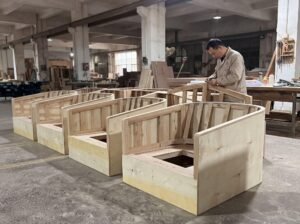
Foshan’s Shunde district, the nerve center of China’s furniture manufacturing ecosystem, has undergone visible reorientation since 2023. Factory floors that historically optimized for North American and European volume orders are now dedicating production lines to regional Asia Pacific specifications. Hotel FF&E projects across Southeast Asia represent a particularly active segment. Thai and Indonesian hotel developers, armed with RCEP-favorable cost structures, are placing larger direct orders for custom guest room packages, lobby seating, and restaurant fixtures than in prior years.
The adjustment is not merely geographic. Regional buyers demand different configurations. Japanese buyers prioritize compact dimensions and formaldehyde emission standards aligned with JIS regulations. Australian buyers require outdoor durability specifications for UV exposure and moisture resistance that differ from European norms. Foshan factories with dedicated export engineering teams have captured this flow, while commodity producers without specification capabilities find themselves confined to lower-margin component supply.
Anji: Office Furniture Exports to Japan and South Korea Surge
Anji County in Zhejiang Province, accounting for a substantial share of global office chair and workstation production, has experienced pronounced demand growth from Northeast Asian markets. Japanese corporate relocation and office renovation cycles, combined with RCEP tariff relief on seating and desk systems, have channeled significant order volume toward Anji manufacturers capable of meeting BIFMA-equivalent testing documentation and Japanese ergonomic preferences.
The surge is not uniform. Anji’s export growth is concentrating among factories that invested in export compliance infrastructure before RCEP took effect. Smaller workshops without in-house customs documentation capability or English-language specification support are struggling to access the same channels, creating a bifurcation between RCEP-ready exporters and purely domestic-oriented producers.
The Component Export Boom: Why Parts Matter More Than Finished Goods
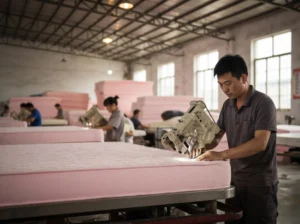
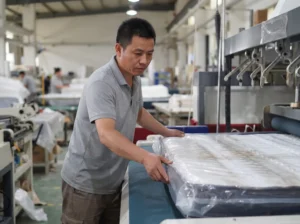
The most underreported dimension of RCEP’s impact on furniture trade is the explosion in component and parts exports from China to ASEAN assembly hubs. Hardware systems, gas lifts, casters, engineered wood panels, upholstery foam, and fabric textiles are crossing borders in volumes that dwarf the growth rates of finished furniture. For reference only, subject to official verification, industry observations from Guangdong and Zhejiang indicate that component export value growth to ASEAN has outpaced finished furniture growth since RCEP implementation, reflecting supply chain restructuring rather than finished goods displacement.
This pattern reflects rational supply chain restructuring. Chinese factories retain high-value, capital-intensive component production while ASEAN factories handle final assembly, leather wrapping, and regional distribution. The RCEP cumulation rule legalizes and incentivizes this division of labor. For buyers, it means that “Made in Vietnam” or “Made in Thailand” labels increasingly represent final assembly locations rather than full manufacturing origins. Understanding where value is actually added—and where quality control is actually exercised—becomes essential for procurement due diligence.
The Compliance Layer: What Buyers and Suppliers Must Get Right
RCEP Certificate of Origin: Cost, Process, and Common Mistakes
Obtaining an RCEP Certificate of Origin is not automatic. Chinese exporters must apply through authorized chambers of commerce or customs-approved issuers, providing detailed commercial invoices, manufacturing process descriptions, and supplier declarations for imported materials. The process typically requires one to three business days for straightforward shipments but can extend longer for complex products with multi-source material inputs.
Common errors that invalidate RCEP claims include incorrect HS code classification, insufficient documentation of regional value content, and failure to maintain supplier records for audit purposes. A Foshan sofa manufacturer using Italian leather and domestic foam must precisely calculate whether the non-RCEP Italian material pushes the product below the 40% regional value content threshold. Misclassification here exposes the importer to retroactive duty assessments and penalties.
| Compliance Element | Typical Cost Range | Processing Time | Common Failure Point |
|---|---|---|---|
| Certificate issuance | $50–$150 per shipment | 1–3 business days | Incorrect HS code on invoice |
| Value content calculation | Internal cost or $300–$800 for third-party verification | 2–5 business days | Missing supplier declarations |
| Material traceability audit | $1,000–$3,000 for facility assessment | 1–2 weeks | Incomplete BOM documentation |
| Retroactive correction | Variable; potential duty penalties plus legal fees | 1–3 months | Discovery during customs audit |
Product-Specific Rules of Origin for Furniture and Components
RCEP’s general 40% regional value content threshold applies broadly, but furniture categories are subject to product-specific rules that buyers and suppliers must verify against the exact HS subheading. Some lines require change in tariff classification (CTH) at the four-digit or six-digit level. Others permit the regional value content method as an alternative. Component trade often faces different thresholds than finished goods.
For example, wooden furniture parts classified under certain HS 94.03 subheadings may qualify under CTH rules if non-originating materials undergo sufficient transformation. Metal furniture hardware may be subject to specific processing requirements. The complexity increases when a single finished product incorporates components spanning multiple HS headings. Suppliers without dedicated trade compliance staff frequently misapply these rules, exposing their buyers to customs risk.
Non-Tariff Barriers That RCEP Does Not Remove
Tariff reduction is not regulatory elimination. RCEP member states maintain independent technical standards, safety certifications, and environmental regulations that furniture imports must satisfy regardless of origin status. Japan’s JIS standards for formaldehyde emissions in wood products remain fully enforced. South Korea maintains KC certification requirements for certain upholstered furniture. Australia’s Consumer Goods Safety Standards apply equally to RCEP and non-RCEP imports.
Furthermore, anti-dumping investigations and countervailing duty proceedings continue outside the RCEP framework. Vietnam has initiated trade remedy measures on certain metal furniture imports despite RCEP membership. Indonesia’s local content requirements for government procurement projects are unaffected by the agreement. Buyers treating RCEP as a blanket permission slip for frictionless trade are misunderstanding its scope.
| Barrier Type | RCEP Impact | Status Post-RCEP |
|---|---|---|
| Customs duties | Reduced per schedule | Still applicable during phase-in |
| Technical standards | Unaffected | Full national enforcement |
| Anti-dumping duties | Unaffected | Active investigations continue |
| Environmental certifications | Unaffected | EUDR-equivalent measures emerging in some markets |
| Local content rules | Unaffected | Government procurement restrictions remain |
| Import licensing | Partial transparency improvements | Still required in some jurisdictions |
The Hidden Risks No One Is Talking About
The “Zero Tariff” Myth and Its Timeline Reality
Industry marketing materials and trade conference presentations frequently imply that RCEP delivered immediate duty-free access across all furniture categories. This is false. The tariff elimination schedules span years and decades. The pace of tariff elimination differs markedly across product classifications and member state schedules. Buyers should not assume universal zero rates based on aggregate headlines, as many furniture categories remain on extended phase-in timelines that stretch well beyond the agreement’s initial effective date.
Buyers negotiating long-term supply contracts based on assumed zero-tariff costs are building budgets on sand. The correct approach models tariff phase-ins explicitly, with price adjustment clauses tied to verified duty rate changes. Suppliers offering “RCEP pricing” without specifying the exact tariff line and effective rate should be pressed for documentation.
Capacity Migration: Are Chinese Factories Moving to Southeast Asia?
The origin cumulation rule and ASEAN market growth are accelerating a trend that predates RCEP: Chinese furniture manufacturers establishing or expanding production presence in Vietnam, Thailand, and Malaysia. This is not mass exodus. It is selective migration of final assembly and labor-intensive finishing operations while design, mold-making, and component manufacturing remain concentrated in China.
The risk to Chinese domestic industry clusters is real but nuanced. Foshan and Dongguan are not hollowing out overnight. However, the long-term trajectory favors a regional production network where Chinese clusters specialize in capital-intensive upstream production and ASEAN facilities handle downstream assembly and regional distribution. Buyers should monitor their suppliers’ geographic footprint. A factory claiming Foshan origin may increasingly be managing production across a multi-country network, with implications for quality consistency, lead times, and accountability.
The Compliance Cost Trap for Small and Medium Exporters
RCEP’s benefits are not equally accessible. Large export groups with dedicated customs brokers, compliance departments, and legal counsel can navigate origin rules, certificate applications, and multi-country documentation with relative efficiency. Small and medium manufacturers—the backbone of China’s furniture export base—often lack these resources.
The cost of obtaining and defending RCEP origin status can range from several hundred to several thousand dollars per product line when third-party verification and legal review are required. For a factory shipping mixed container loads of diverse SKUs to multiple RCEP destinations, the administrative burden becomes prohibitive. The result is a two-tier market where large exporters capture RCEP margins and smaller competitors remain stuck in bilateral FTA frameworks or standard duty-paid trade. This concentration effect is rarely discussed in policy analyses but is plainly visible in export data showing market share consolidation among top-tier suppliers.

What This Means for Different Players in the Market
For Asia Pacific Importers: How to Capture RCEP Savings
Importers in Japan, South Korea, Australia, and ASEAN should start with HS code verification. Request the precise classification from every supplier and cross-reference the applicable RCEP tariff schedule for your country. Do not accept generalized assurances of “RCEP pricing” without documentation. Second, evaluate whether your supplier’s production network qualifies for origin cumulation. If you are sourcing from a Vietnamese assembler using Chinese components, confirm that the supplier maintains proper material traceability records. Third, compare RCEP against existing bilateral FTAs. For direct imports from China, ChAFTA or the China-South Korea FTA may still offer superior terms. Choose the agreement that minimizes your landed cost, not the one that generates the most marketing enthusiasm.
For Chinese Suppliers: Maximizing RCEP Benefits Without Compliance Errors
Chinese manufacturers must invest in trade compliance capability before chasing RCEP markets. This means training sales staff to understand origin rules, maintaining detailed supplier records, and establishing relationships with authorized certificate issuers. Factories exporting components to ASEAN assembly operations should structure their sales documentation to support their customers’ downstream RCEP claims. Component suppliers who provide origin-friendly documentation become preferred partners in regional supply chains. Finally, suppliers should audit their own material inputs. Every non-RCEP raw material—European leather, American timber, Taiwanese hardware not routed through qualifying channels—potentially jeopardizes origin status. Know your bill of materials with precision.
For Global Buyers Outside RCEP: Understanding the Competitive Shift
European and North American buyers should recognize that RCEP is reshaping global furniture trade flows regardless of their direct involvement. As Asia Pacific regional trade costs decline, Chinese manufacturers are diversifying revenue streams toward regional markets. This reduces dependency on Western demand and may alter pricing power dynamics. Additionally, the component trade boom means that furniture labeled as ASEAN-origin is increasingly built on Chinese industrial foundations. Buyers evaluating “China plus one” strategies should understand that the alternative may still be deeply China-dependent. RCEP is accelerating regional integration, not creating genuinely independent alternative supply bases.

FAQ: RCEP and Furniture Trade in the Asia Pacific
Does RCEP mean zero tariffs on all furniture immediately?
No. RCEP structures tariff elimination across phased schedules that vary by product HS code and country pair. Many furniture categories will retain partial duties until 2028, 2030, or later. Immediate zero tariffs apply only to specific lines where baseline rates were already low or where accelerated commitments were made. Buyers must verify the exact tariff line and phase-in year for their specific products.
How do I claim RCEP tariff benefits when importing furniture?
Your supplier must obtain an RCEP Certificate of Origin from an authorized issuing body in the exporting country, typically a chamber of commerce or customs-designated agency. You submit this certificate with your import declaration. The certificate must specify the exact product description, HS code, and origin criterion met. Keep the certificate and supporting commercial documentation for the retention period required by your national customs authority, typically three to five years.
Can I use RCEP benefits if my furniture is assembled in Vietnam using Chinese parts?
Yes, if the finished product meets the applicable RCEP rule of origin. Under regional cumulation, materials from any RCEP member state can count toward regional value content or tariff classification requirements. The Vietnamese assembler must maintain documentation tracing the Chinese-origin components and demonstrating that the final product satisfies the relevant product-specific rule. The origin criterion claimed on the certificate must accurately reflect the cumulation method used.
Which is better for furniture imports: RCEP or the existing bilateral FTA?
It depends on your specific product, sourcing configuration, and trading partner. For direct imports of China-origin finished furniture into Australia, the China-Australia FTA often provides equivalent or better terms with simpler documentation. For triangular trade involving materials or assembly across multiple RCEP countries, RCEP is typically the only viable framework. For China-Japan trade, RCEP is the primary preferential agreement covering furniture. Importers should model landed costs under each available agreement before selecting a preference.
Will RCEP cause Chinese furniture factories to relocate to ASEAN countries?
Selective relocation of final assembly and finishing operations is already occurring, but this is not a mass exodus. Chinese clusters retain dominant positions in component manufacturing, mold-making, design, and capital-intensive production. RCEP accelerates regional division of labor by legitimizing cross-border component trade through cumulation rules. The long-term trajectory points toward integrated regional networks rather than wholesale replacement of Chinese manufacturing. Buyers should expect increasing geographic complexity in their suppliers’ production footprints.

Recommended Resource
Interi Furniture specializes in custom furniture manufacturing for residential, hospitality, and commercial projects. Their experience in materials, craftsmanship, and project realization makes them a valuable resource for designers and buyers seeking tailored furniture solutions from China.