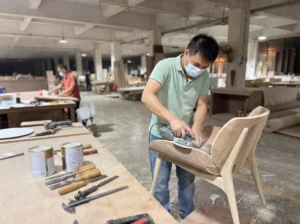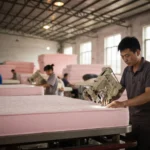


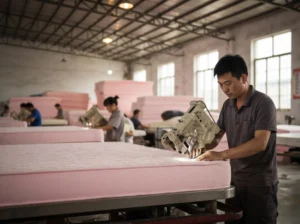

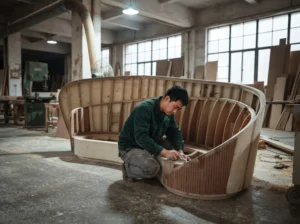





China furniture warranty 1 year coverage in cross-border procurement delivers far less protection than the paper promise implies. On most Chinese factory invoices, this warranty functions as a commercial goodwill gesture rather than a legally enforceable cross-border guarantee. The coverage typically extends only to catastrophic manufacturing failures such as frame structural collapse or major welding fractures, while excluding the problems buyers actually encounter: fabric fading on upholstered pieces, cushion compression in sofas, hardware loosening on dining sets, and environmental adaptation failures in humid or dry climates. The claim process demands evidence standards that most personal buyers cannot meet, operates across communication barriers that factories exploit, and ultimately relies on legal jurisdictions where individual overseas buyers have no practical recourse. For personal buyers purchasing single pieces or small batches, the practical protective value of this warranty approaches zero. The real risk control must happen before payment, not after delivery.
Why Buyers Assume They’re Protected (And Why That Assumption Is Dangerous)
The Western Warranty Mentality Meets Chinese Export Reality
Buyers from North America, Europe, and Australia enter the Chinese furniture market carrying institutional expectations shaped by domestic consumer protection frameworks. In Western markets, a one-year warranty carries statutory backing, clear coverage boundaries, and accessible dispute resolution through small claims courts or consumer agencies. Chinese export warranties operate in an entirely different ecosystem. Chinese consumer protection law, including the Consumer Rights and Interests Protection Law, holds no jurisdictional authority over transactions with overseas personal buyers. The factory warranty is a unilateral format term drafted by the supplier, not a bilateral agreement subject to neutral arbitration. Buyers who assume that a WeChat conversation promising “1 year warranty” creates the same legal relationship as a warranty card from a domestic retailer fundamentally misunderstand the legal architecture of international B2B and cross-border B2C furniture trade.
How Suppliers Use Warranty as a Sales Tool
Factory sales teams deploy warranty language as a conversion optimization device, not as a financial liability reserve. During trade show negotiations at Canton Fair or CIFF Guangzhou, the warranty commitment often emerges as a closing tactic after price resistance surfaces. Sales representatives know that overseas buyers lack the infrastructure to verify whether the factory maintains warranty reserve funds or product liability insurance. Most small-to-medium factories in competitive price segments operate on margins that cannot absorb cross-border warranty fulfillment costs. The warranty promise secures the order; the exclusion clauses buried in product specifications or packing list notes neutralize the obligation after shipment. This is not universal malpractice, but it is the dominant pattern among price-competitive exporters serving the sub-$500 per unit market.
What ‘1 Year Warranty’ Actually Covers vs. What Buyers Think It Covers
The Legal Definition of a Chinese Factory Warranty
Legally, the one-year warranty on a Chinese factory invoice constitutes a contractual offer of limited repair or replacement for manufacturing defects attributable to the production process. It is not a product liability guarantee, not an insurance policy, and not a satisfaction guarantee. The factory retains sole authority to determine whether a defect falls within warranty scope, and the buyer bears the burden of proving that the defect existed at the point of manufacture rather than arising during international shipping, customs handling, or local delivery. This definition places the evidentiary and logistical burden entirely on the buyer from the outset.
The Coverage Categories: Manufacturing Defects, Materials, Workmanship
When factories honor warranty claims, the resolution typically covers three narrow categories. Structural frame breakage in solid wood or metal furniture resulting from incorrect joinery or welding represents the most commonly accepted claim. Material defects limited to factory-applied finishes, such as peeling lacquer or delaminating veneer caused by production errors rather than environmental exposure, occasionally qualify for partial coverage. Workmanship failures including misaligned pre-drilled holes or incorrect assembly hardware sets may result in replacement parts shipped at buyer expense. These categories exclude the functional failures that generate most buyer complaints: sagging sofa cushions, loose joints from repeated use, and surface damage from normal household conditions.
The Exclusions That Erase Most Claims
The gap between buyer expectation and factory obligation is where most warranty claims die.
| What Buyers Typically Expect | What the Factory Warranty Actually Covers |
|---|---|
| Shipping damage from container handling or last-mile delivery | Explicitly excluded; buyer must claim against freight forwarder or shipping insurance |
| Fabric fading, pilling, or texture changes on upholstered furniture | Excluded as “normal wear and tear” or “environmental exposure” |
| Cushion compression or loss of resilience in sofas and mattresses | Excluded as “normal usage deformation” unless catastrophic collapse occurs |
| Hardware loosening on chairs, tables, or beds after assembly | Excluded unless original factory torque settings were demonstrably incorrect |
| Cracking or warping caused by humidity or temperature differences between China and destination country | Excluded under “environmental factor” disclaimers |
| Surface scratches or finish damage discovered after unpacking | Excluded unless buyer proves defect existed before export packing |
| Any issue requiring full product return to China | Economically excluded by shipping cost provisions that place return freight on buyer |
How the Warranty Claim Process Actually Works (Or Doesn’t)
The Communication Barrier: Time Zones, Language, and Disappearing Acts
The warranty claim process begins with a communication architecture designed for delay. Factory sales staff who responded within minutes during pre-sale negotiations often shift to 24-to-48-hour response cycles after payment clearance. English-language communication frequently passes through staff with transactional vocabulary but no technical fluency, leading to misunderstandings about defect descriptions. Critical details about defect location, severity, and causal chain get lost in WeChat message threads or Alibaba inquiry translations. Some factories intentionally cycle communication through multiple staff members to fragment accountability. For personal buyers in Western time zones, the effective communication window shrinks to a few hours daily, extending a simple claim into weeks of asynchronous messaging.
The Evidence Requirement: Photos, Videos, and the “Official Report” Trap
Factories demand evidence packages that exceed what most buyers can produce. Standard requirements include high-resolution photographs showing the defect in context of the full product, unedited video documentation demonstrating the functional failure, scanned copies of the original packing list and commercial invoice, and proof that the product was assembled exactly according to factory instructions. The most effective exclusion mechanism is the demand for an official inspection report from a recognized third-party testing laboratory. For reference only, subject to official verification: the cost of obtaining such a report for a single furniture piece typically ranges from $200 to $800, not including sample shipping and testing duration. When the furniture unit cost falls between $300 and $1,500, this evidence requirement alone eliminates the economic rationale for pursuing the claim.
The Shipping Cost Trap: Why Returning a Sofa to China Costs More Than Buying a New One
Even when a factory accepts a warranty claim, the logistics of fulfillment often render the victory hollow. Warranty terms almost universally require the buyer to bear return shipping costs for repair or replacement. A standard three-seat sofa shipped from Los Angeles to Shenzhen via sea freight incurs port-to-port costs, origin and destination handling fees, Chinese import duties on the returning goods, and potential customs inspection delays. For reference only, subject to official verification: the total cost of returning a single upholstered sofa to China frequently exceeds $1,200, while the original purchase price may have been $800 to $1,000. The factory knows this arithmetic. The warranty clause is structured precisely so that the shipping cost provision acts as a self-executing denial mechanism.
Factory Loopholes and Escape Clauses
The “Improper Use” Defense
Factories routinely reject claims by asserting that the buyer assembled, used, or maintained the product incorrectly. A dining chair rated for 150 kg in factory specifications may be deemed “overloaded” at 100 kg in a Western market where average body mass differs from Chinese testing baselines. Outdoor furniture placed in direct sunlight may be rejected for “improper environmental exposure” despite lacking explicit UV-resistance warnings in English. The improper use defense shifts the causal burden to buyer behavior without requiring the factory to prove that the product was actually misused.
The “Natural Wear and Tear” Exclusion
This exclusion absorbs the majority of functional complaints. Soft furniture cushion compression, fabric texture changes after cleaning, wood finish patina development, and metal surface oxidation all fall under natural wear and tear regardless of how early they manifest. The factory defines the boundary between “defect” and “wear” arbitrarily, and buyers have no contractual mechanism to challenge that definition.
The “No Original Packaging” Rejection
A particularly insidious exclusion requires the buyer to retain all original export packaging for warranty validity. International ocean freight packaging for furniture consists of bulky cardboard, foam inserts, and wooden crates that consume significant storage space. Personal buyers receiving container loads or even single pieces through consolidated freight almost immediately discard this packaging. Six months later, when a frame crack appears, the factory cites the absence of original packaging as grounds for rejection, claiming that improper storage or handling after unpacking caused the defect.
The “Environmental Factors” Disclaimer
Wood furniture shipped from humid Southern China to arid Arizona or cold Northern Europe experiences dimensional stress. Factories disclaim responsibility for cracking, joint separation, or veneer lifting caused by humidity differentials between manufacturing environment and buyer location. This exclusion effectively nullifies warranty protection for solid wood furniture in most non-tropical destination markets, yet buyers rarely see this disclaimer prominently displayed during purchase.
The Cross-Border Enforcement Problem
Why a Chinese Factory Warranty Is Nearly Unenforceable Overseas
The structural problem with Chinese factory warranties is not factory dishonesty but legal geography. A warranty promise made by a factory in Foshan or Ningbo has no automatic legal standing in California, London, or Sydney. The factory is a Chinese legal entity operating under Chinese law. The buyer is a foreign consumer or small business with no legal presence in China. Cross-border consumer protection treaties do not create direct enforcement mechanisms for individual furniture purchases. The warranty exists in a legal vacuum where the only practical enforcement tool is the factory’s own commercial reputation, which carries weight only for factories that depend on repeat orders or platform ratings.
The Jurisdiction Trap: Chinese Courts and Governing Law Clauses
Most export contracts, whether formal purchase agreements or Alibaba order confirmations, contain governing law clauses specifying Chinese law and jurisdiction in Chinese courts. This clause is not negotiable for small buyers. Pursuing a warranty claim through Chinese litigation requires retaining Chinese legal counsel, filing in the appropriate district court near the factory, and navigating a civil procedure system where documentary evidence standards differ from Western expectations. For claims under $5,000, the legal costs alone make this path irrational. The factory knows that no overseas personal buyer will litigate in China over a single sofa or dining table.
The Cost-Benefit Math That Kills Most Claims
For reference only, subject to official verification: industry observations suggest that cross-border warranty claims on single-unit or small-batch furniture purchases from China succeed in full replacement or cash refund in fewer than 5% of cases where the buyer is an overseas personal consumer. Partial resolutions, typically consisting of replacement hardware or discount coupons for future orders, occur in approximately 15% of cases. The remaining 80% of claims stall in communication loops, evidence disputes, or buyer abandonment due to cost exhaustion. These figures reflect the economic reality that warranty enforcement for low-value cross-border consumer goods is structurally uneconomical for both parties, but the asymmetry favors the factory because the buyer has already paid.
Realistic Protection Strategies for Buyers
For Personal Buyers: Pre-Purchase Due Diligence Over Post-Purchase Warranty
Personal buyers must abandon the fantasy of warranty protection and invest in pre-purchase risk reduction. This means ordering material samples before full production to verify fabric durability and wood finish quality. It means requesting unedited factory video of the actual production run rather than stock photography. It means using secure payment methods that retain leverage until delivery confirmation. It means accepting that a $400 dining chair from a factory with no overseas service infrastructure carries inherent risk that no warranty clause can mitigate. The most effective warranty is the one you never need to invoke because the product was right before shipment.
For B2B Buyers: Building Enforceable Warranty Terms Into the Purchase Contract
Small B2B buyers, including hospitality operators and interior designers, possess slightly more leverage because their order volumes justify custom contract terms. Enforceable warranty protection requires specific language: explicit definition of covered defects with reference to international standards such as ASTM or EN furniture testing protocols, assignment of inspection rights to third-party QC agents at the factory before shipment, retention of a percentage of payment pending installation confirmation, and agreement that unresolved defects trigger proportional refund rather than return-to-factory repair. These terms must be in the purchase contract, not in a post-sale warranty leaflet.
When Third-Party Inspection Replaces Warranty Trust
Third-party pre-shipment inspection is the only warranty substitute that actually functions across borders. A professional inspector visiting the factory before container loading can identify frame defects, upholstery inconsistencies, and finish problems that would otherwise become warranty disputes after arrival. The inspection report creates documentary evidence that forces the factory to address defects before payment release. For buyers, this transforms the risk model from post-damage recovery to pre-damage prevention.
| Buyer Type | Effective Protection Strategy | Key Action Items | Warranty Reliance Level |
|---|---|---|---|
| Personal consumer purchasing 1–5 pieces | Pre-purchase sample verification + secure payment + platform-mediated dispute | Order material samples; use escrow or credit card chargeback rights; photograph unpacking process | Minimal; treat warranty as symbolic |
| Micro B2B buyer purchasing 5–20 pieces for commercial project | Custom contract terms + third-party pre-shipment inspection + payment retention | Define defect standards in contract; hire QC inspector at factory; withhold 10–15% payment until installation | Low; use contract terms as functional warranty |
| Procurement agent representing overseas clients | Supplier audit + production monitoring + consolidated inspection reporting | Verify factory export history and insurance status; monitor mid-production; deliver inspection report to client before shipping | None; professional accountability replaces warranty |

FAQ: Chinese Furniture Warranties
Does a 1-year warranty from a Chinese factory cover shipping damage?
No. Shipping damage falls under freight insurance and carrier liability, not factory warranty. The factory warranty covers manufacturing defects only. If your furniture arrives damaged from container handling, you must file a claim with your shipping company or the insurance underwriter covering the cargo policy. The factory will direct you to the freight forwarder immediately.
Can I get a refund under a Chinese furniture warranty?
Cash refunds are extremely rare under standard Chinese factory warranties. Most warranty terms specify repair or replacement only, and replacement typically requires you to pay return shipping for the defective item. Some factories offer partial refunds or discount credits for future orders as goodwill gestures, but this is discretionary and usually occurs only for buyers with ongoing business relationships.
What evidence do I need to file a warranty claim with a Chinese supplier?
Requirements vary by factory but commonly include clear photographs of the defect from multiple angles, video showing the functional failure if applicable, copies of the original invoice and packing list, proof of purchase date, and documentation that you assembled and used the item according to factory instructions. Some factories demand an official inspection report from a certified testing laboratory, which costs more than the furniture itself for single-unit claims.
Is a Chinese factory warranty legally enforceable in the US or Europe?
Not directly. Chinese factory warranties are governed by Chinese law and Chinese court jurisdiction in most export contracts. They have no automatic legal standing in US or European courts. Enforcement would require litigation in China, which is economically irrational for individual furniture purchases. Your practical recourse is limited to platform-mediated disputes if you purchased through Alibaba or similar marketplaces, or credit card chargeback if you paid by card and the transaction qualifies.
Which furniture categories have the highest warranty failure rates?
Upholstered soft furniture, including sofas and mattresses, generates the highest volume of warranty disputes due to subjective quality standards for cushion resilience and fabric wear. Solid wood furniture follows closely because of environmental adaptation failures when shipped to climates with humidity levels different from the manufacturing region. Metal furniture with powder-coated finishes has lower dispute rates for structural issues but higher rates for surface finish complaints. Stone and marble furniture, particularly from Yunfu sourcing clusters, rarely experiences structural warranty claims but frequently generates disputes about natural vein patterns versus actual cracks.

Recommended Resource
Interi Furniture specializes in custom furniture manufacturing for residential, hospitality, and commercial projects. Their experience in materials, craftsmanship, and project realization makes them a valuable resource for designers and buyers seeking tailored furniture solutions from China.