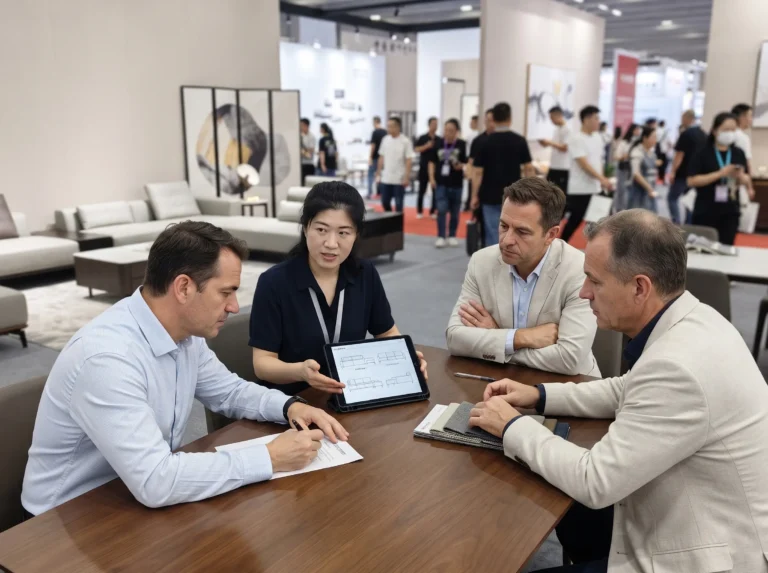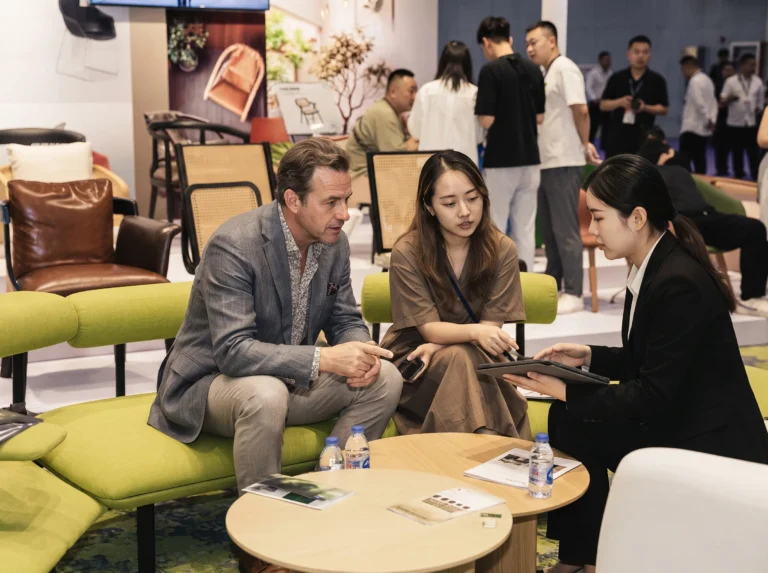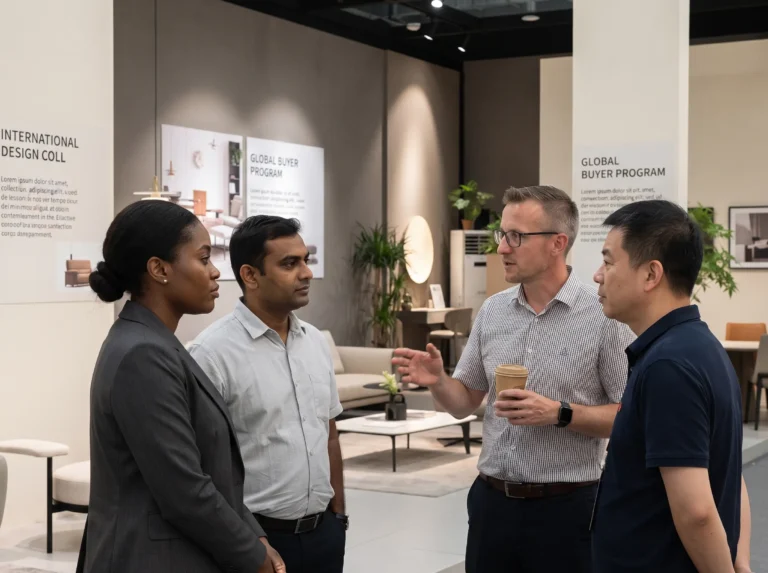






The first thing you need to unlearn? There’s no “best” place to buy outdoor furniture in China. Only the place that matches your specific mess — your budget, your volume, your product, your pain tolerance. Zhejiang vs Guangdong outdoor furniture isn’t a boxing match with a clear winner. It’s more like two restaurants serving food from the same country. One does Michelin-style tasting menus. The other does high-volume catering. Both can be excellent. Both can burn you if you walk through the wrong door.
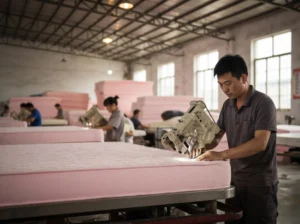
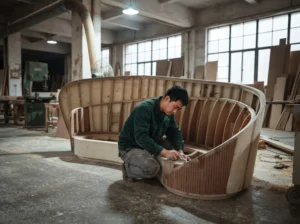
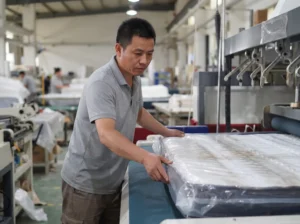
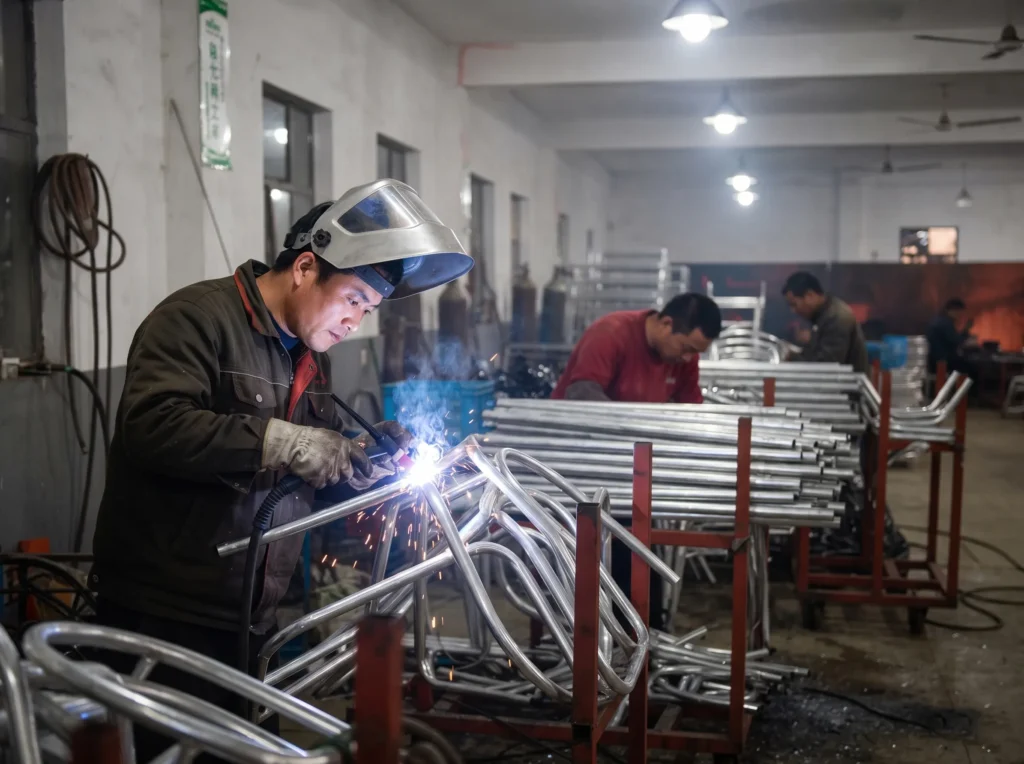
We’ve been on factory floors in Shunde’s Longjiang township at 10 p.m. during peak season. Welding sparks everywhere. A German hotel chain needs 500 aluminum dining sets shipped before Canton Fair. The floor manager hasn’t slept in two days. We’ve also sat in Linhai’s Yotrio Group conference room — automated powder-coating lines humming in the background, enough patio furniture moving through to stock a Walmart Supercenter. Same country. Same industry. Two completely different universes. If you don’t understand the split, you’ll pay for materials you don’t need, get strangled by MOQs you can’t meet, or wait six weeks while a factory wonders why you’re bothering them with an order they were never built to handle.
What the Numbers Actually Say
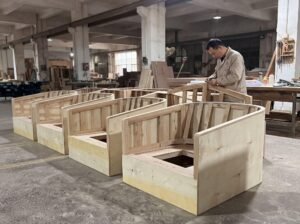
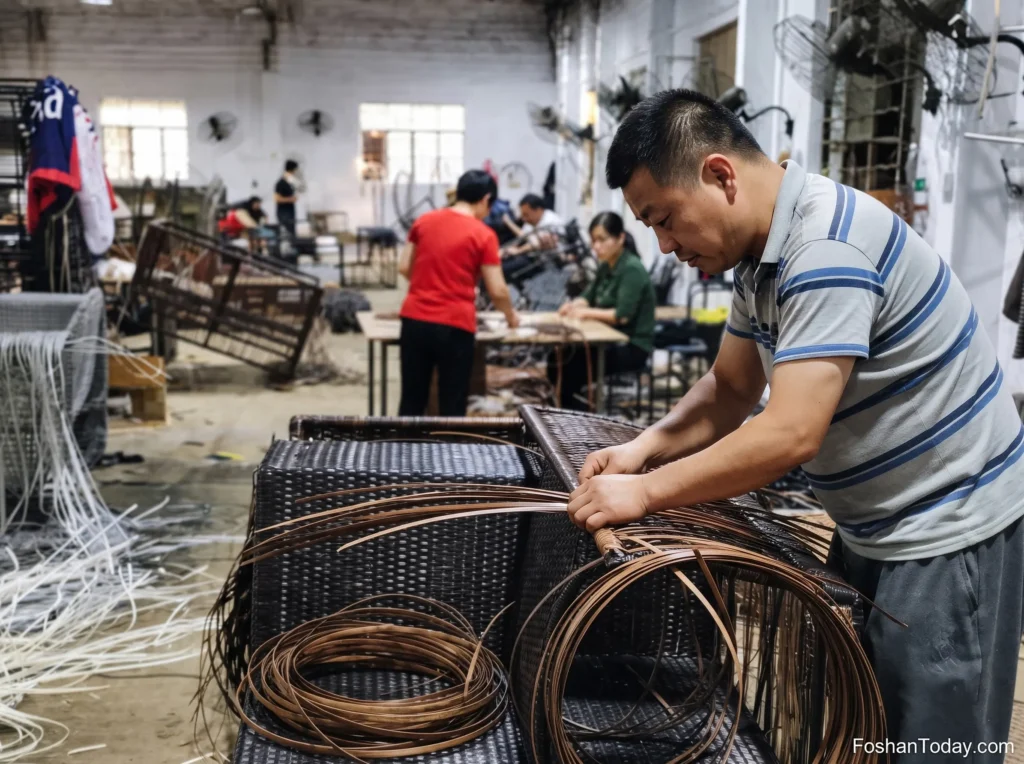
Foshan, Guangdong’s furniture capital, pumps out over 1.2 trillion RMB in annual industrial output. Just the Shunde district alone holds more than 30,000 furniture-related enterprises — 9,000-plus actual manufacturers, over 20,000 trading entities. Longjiang township? 2,300 manufacturers and 7,000 raw material suppliers packed into an area so dense you can get from an aluminum extruder to a powder-coating line to a PE rattan weaver in under 15 minutes. That’s why a CAD file can become a physical sample in 72 hours. Not because anyone’s magic. Because everyone’s next door.
Zhejiang tells a different concentration story. Linhai, a county-level city under Taizhou, hosts over 1,000 dedicated outdoor furniture firms pushing annual exports past 20 billion RMB. Their sunshades and swings alone grab more than 30% of global market share. Head over to Ningbo, Yuyao, and Cixi — industry estimates say over 60% of the aluminum outdoor dining and lounge sets sitting in Western retail chains come from this pocket. Massive scale. Different DNA.
Why Guangdong Owns Premium and Zhejiang Owns Volume
Guangdong’s belt — Shunde, Guangzhou Panyu, the surrounding web — has morphed into something high-end and project-hungry. These factories don’t just make furniture. They serve hospitality procurement teams, luxury retail brands, commercial developers. The kind of buyers who won’t issue a PO without EN581 structural reports, BSCI audits, FSC chain-of-custody paperwork already in hand.
Walk into Higold in Xingtan Town, Shunde. Industrial design teams sketch proprietary aluminum frame profiles that’ll end up in Marriott courtyards. Step into Dihui over in Jiujiang Town. They’re engineering die-cast aluminum fire pits to survive salt-spray specs most Zhejiang factories have never been asked to touch. That’s Guangdong’s edge — deep vertical integration in premium materials. Stainless steel 316. Plantation teak. Cast aluminum. High-grade powder-coating that hits 80 to 110 microns for coastal hospitality projects. Decades of export muscle to Europe, North America, the Middle East.
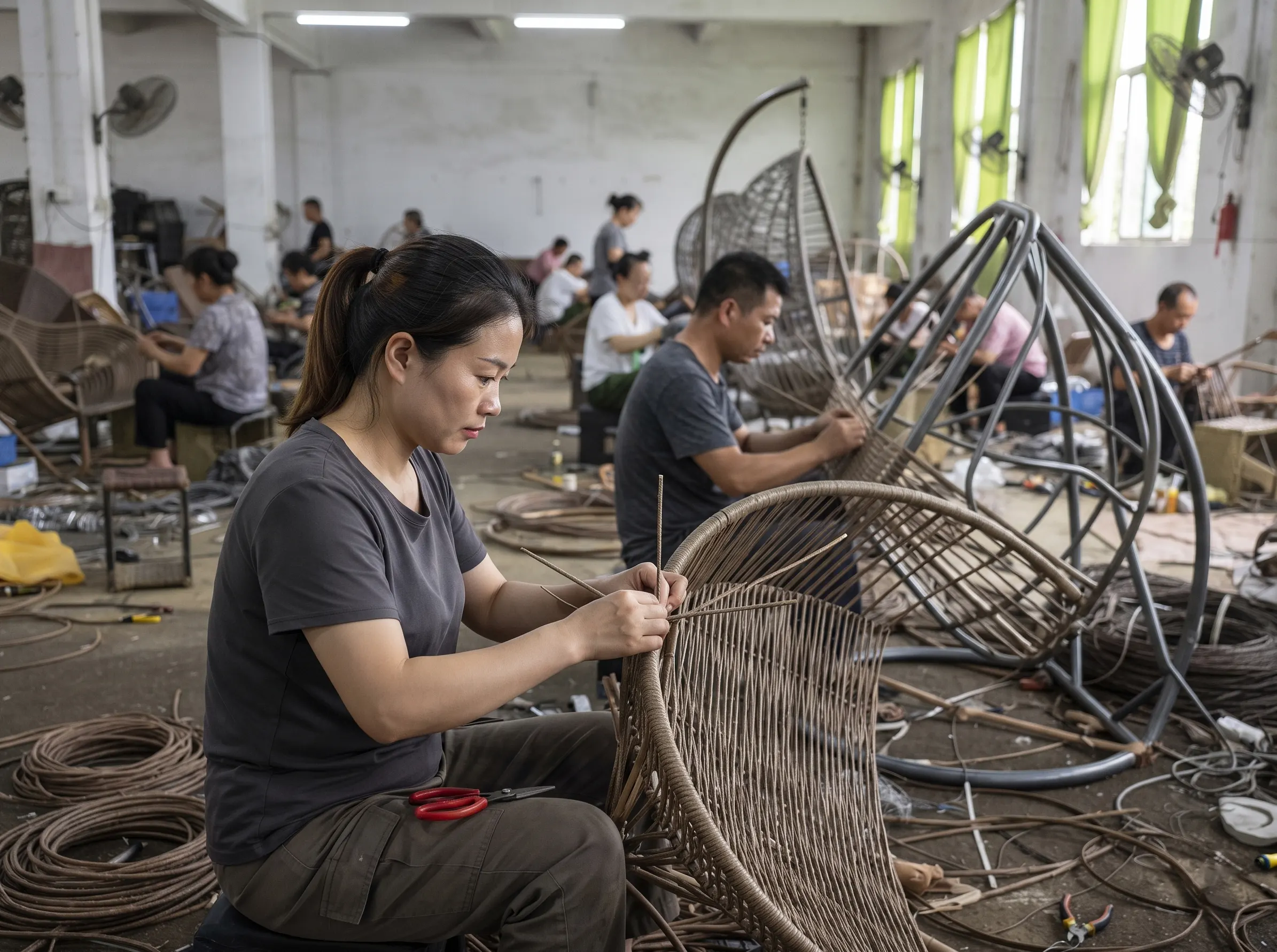
Zhejiang’s Linhai and Ningbo belts run on a different fuel. Scale. Speed. Container-load efficiency. Yotrio Group on Linhai Avenue is the world’s largest outdoor furniture manufacturer by volume — not by accident. Their supply chain is tuned to fill boxes, not to hand-hold boutique hotel FF&E projects. These factories crush standardized aluminum tube-and-sling sets, PE rattan sofa combinations, sunshade systems where the engineering is proven and the only question is whether they can hit the FOB number for a Costco seasonal buy.
Not a knock. It’s specialization. Need 2,000 identical patio dining chairs in 45 days? Zhejiang wins on price and speed almost every time. Need a custom rope-and-teak lounge set with marine-grade hardware and individual carton branding for a Bali boutique resort? Guangdong is where that capability actually lives.
Material reality follows this split almost perfectly. Guangdong dominates premium metal and hardwood outdoor furniture. Shunde and Nanhai are the global epicenter for high-end aluminum outdoor — precision extrusion, TIG welding, multi-layer powder-coating. They also own cast and die-cast aluminum, where expensive molds buy you structural stability tubular aluminum can’t match. For teak and hardwood, Guangdong’s proximity to timber import ports plus generations of fine woodworking give it depth Zhejiang simply doesn’t have.
Zhejiang, meanwhile, rules the volume aluminum game — lightweight, powder-coated tube frames sold by the pallet — and has built enormous automated PE rattan weaving and sunshade capacity. Brafab out of Zhejiang has carved out a solid rope-and-teak niche. But it’s the exception. Most Zhejiang output is mid-market, high-volume, standardized SKUs. That’s the rule.
Where Guangdong’s Strength Becomes Your Problem
Here’s what breaks buyers more than anything: MOQ and responsiveness. The “Guangdong is best” story falls apart here. Hard.
Yes, Guangdong has the biggest names. The deepest supply chain. But those advantages create a capacity-saturation trap. A 200-employee Shunde factory running three shifts for Home Depot and a French supermarket chain doesn’t have bandwidth for your 50-set custom order with modified cushion colors. Their sales team quotes 30 to 50 sets minimum for catalog items, 100-plus for anything custom. Not because they’re arrogant. Because retooling their line for your small batch genuinely wrecks their economics.
We’ve watched buyers get quoted 40-set MOQs for aluminum dining sets in Shunde. Same buyers fly to Linhai. Same product. 10-set MOQ. Faster sample turnaround. The Zhejiang factory was hungry. The Guangdong giant had already filled every production slot through Q3.
For individual buyers or small e-commerce operators, this gap gets worse. Guangdong’s factory landscape is split between massive OEM manufacturers with fortress-level MOQs and tiny trading shops that’ll promise you the moon but can’t control quality. The middle tier — 50 to 150 employees, small-batch capable, reasonable quality — is harder to find in Foshan than most people think. Real estate and labor costs have pushed smaller manufacturers to the edges or out of business entirely.
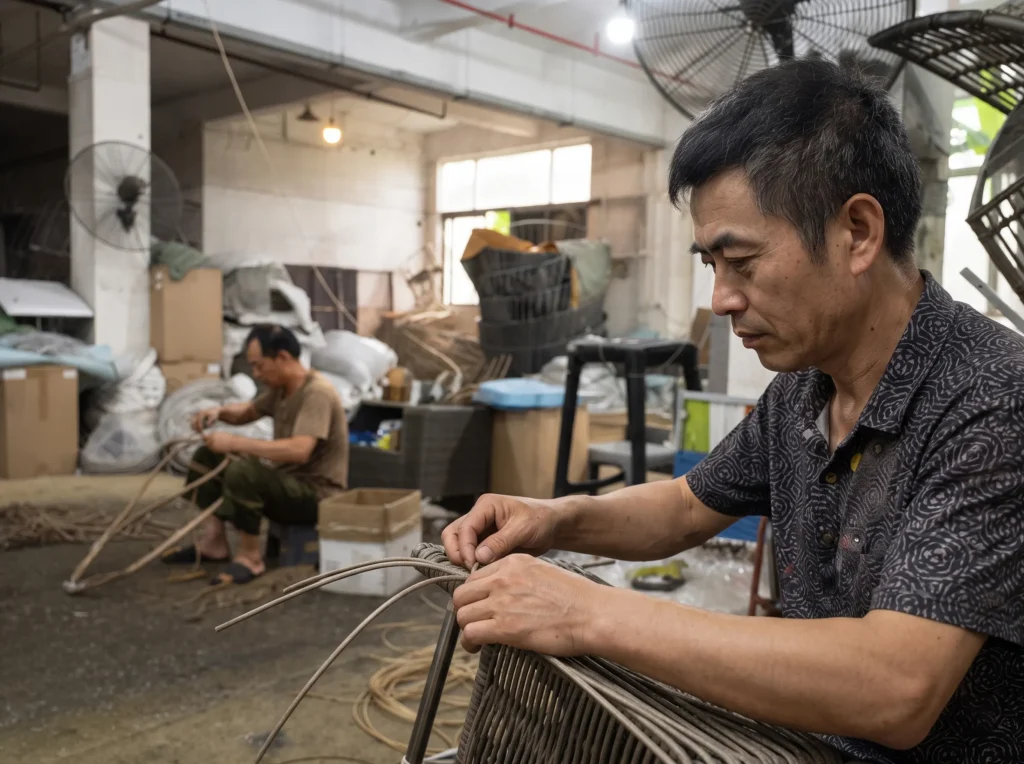
Zhejiang’s middle tier, especially around Linhai and Ningbo’s suburbs, is still alive. These factories grew up serving export trading companies that needed to mix one container with 20-set orders from five different buyers. Flexibility is in their blood. Startup Amazon seller testing a new outdoor sofa? Boutique hotel owner renovating twelve rooms? Zhejiang’s ecosystem is objectively more welcoming. No question.
“Cheaper” Is a Dangerous Word
The assumption that Zhejiang is always cheaper because it’s “the volume belt” misses a critical nuance. Zhejiang factories have dumped serious money into automated powder-coating, precision aluminum cutting, high-grade PE rattan weaving over the past decade. For certain premium aluminum and rattan categories, their unit costs aren’t lower than Guangdong. Sometimes they’re higher. The technology premium is real.
We’ve seen it on factory floors. Identical-looking outdoor sofa sets. Zhejiang quote comes in noticeably above Guangdong. Why? Thicker aluminum profile. Higher-grade powder coat. UV-stabilized cushion fabric the Guangdong factory didn’t even include in its base spec. The buyer assumed “Zhejiang = cheaper” and almost overpaid for specs they didn’t ask for.
Flip side: basic tubular aluminum sling chairs, standard PE rattan dining sets. Zhejiang undercuts Guangdong by a solid margin at volume. Every time. The price gap isn’t geography. It’s specification depth and who the factory’s real customer is. Hotel project orders? Pricing bakes in compliance and customization. Retail chain orders? Pricing optimizes for throughput and repeatability. Two different math problems.
The Compliance Gap (It’s Real, But Shrinking)
Guangdong still holds an edge here. Measurable. Because its outdoor furniture industry grew up feeding European and North American markets through Hong Kong trading houses and direct big-brand OEM contracts, leading factories have compliance in their bones. ISO 9001 is barely worth mentioning. BSCI or amfori audits? Standard for any EU-bound factory. FSC chain-of-custody? Common among teak and hardwood manufacturers. REACH for EU coatings and fabrics, EN581 for seating and table structure, BIFMA X5.6 for US commercial projects — Guangdong factories produce these without blinking.
Yotrio and Zhengte in Zhejiang absolutely hold these certifications. But dig one tier below the top players and documentation gets patchy fast. For EU market entry, where REACH and EN581 are increasingly non-negotiable, this matters. Selling into US residential through Amazon or Wayfair? Certification requirements are lighter. Zhejiang’s gap becomes less of a hurdle.
How to Actually Choose
After years of watching expensive mistakes, we’ve boiled this down to four variables. Forget the province name on the business license. These four things decide whether you’ll get a good factory experience or a nightmare.
Product type is first. Cast aluminum, marine-grade stainless, plantation teak, high-design rope furniture — start in Guangdong. Standard aluminum tube sets, PE rattan combos, sunshades, swings — start in Zhejiang.
Order scale matters more than people admit. Single SKU, 500-plus sets? Guangdong’s economies of scale and supply-chain depth pay off. Ten to 100 sets? Mixing multiple SKUs in one container? Zhejiang’s flexible mid-tier factories treat you like a human being.
End customer changes everything. Hospitality and commercial with strict compliance — lean Guangdong. Mass retail, e-commerce, residential — lean Zhejiang.
And your identity. Corporate buyer with a procurement team? You can absorb Guangdong’s factory onboarding overhead. Individual buyer sourcing a personal project? You’ll get lost in Guangdong’s factory hierarchy. Zhejiang’s more accessible mid-size operations will actually answer your emails.
The Showroom Lie and the Tariff Math
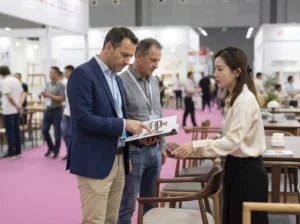
Buyers fly to Foshan, walk through Lecong Furniture Market, and think they’re getting close to factory-floor pricing. They’re not. Lecong is a trading market. Most showrooms aren’t manufacturers. They’re aggregators marking up factory prices 15 to 40 percent, then outsourcing to whoever has capacity that month. For real factory-direct pricing in Guangdong, drive to Longjiang or Xingtan industrial zones. Talk to production managers. Commit to volume. Otherwise you’re paying a tourist tax.
In Zhejiang, Linhai’s industrial parks cluster tighter around actual manufacturing. The showroom-to-factory distance is shorter. But the same warning applies: the guy with the nicest showroom rarely has the best factory price.
Tariffs. The thing nobody wants to talk about but everyone has to pay. As of mid-2026, Chinese outdoor furniture entering the US faces 25% ad valorem under Section 301. Planned bump to 30% is deferred until at least 2027. Applies whether you ship from Guangdong or Zhejiang. No escape.
But the landed-cost math diverges. Guangdong’s higher base FOB plus 25% means a bigger absolute dollar hit per unit. Zhejiang’s lower base prices soften the blow slightly for mid-market goods. Buying premium spec from Zhejiang? The tariff still smacks a bigger number than you’d expect. EU buyers face 0 to 5.6% MFN duties, no Section 301 equivalent. Their choice should be pure product fit and factory capability. No tariff gymnastics required.
The Only Strategy That Works
Buyers who lose money didn’t pick the wrong province. They picked the right province for the wrong reasons. Guangdong isn’t better than Zhejiang. Zhejiang isn’t cheaper than Guangdong. Two different manufacturing philosophies. Two different buyer profiles. Match your product, your scale, your compliance needs, and your operational bandwidth to the belt built for you. That’s the only strategy that doesn’t die on a Chinese factory floor.

FAQ
Why do identical outdoor sofa sets sometimes cost significantly more in Zhejiang than in Guangdong?
Specification depth. Not geography. Zhejiang’s premium factories often run thicker aluminum, higher-grade powder coat, UV-stabilized cushion fabrics — stuff a Guangdong factory might exclude from its base quote. We’ve seen this on factory floors repeatedly. Flip it around: basic tubular aluminum and standard PE rattan? Zhejiang undercuts Guangdong at volume. Compare specs line by line. Province labels come second.
Is Guangdong always the better choice for high-end hotel and resort projects?
Usually. Not automatically. Guangdong’s deeper EN581, BSCI, FSC, REACH experience makes it safer for hospitality procurement. But Yotrio and Zhengte in Zhejiang hold these certs and handle large resort orders. The difference: compliance is woven into Guangdong’s entire belt culture. In Zhejiang it’s concentrated at the top tier. Source below the top ten Zhejiang exporters? Verify every certificate yourself. No exceptions.
Can individual buyers or small e-commerce sellers get fair treatment in Guangdong?
Possible. Takes work. Guangdong’s ecosystem is split between massive OEMs with fortress MOQs and tiny trading shops with random quality. The accessible middle tier — 50 to 150 employees, small-batch capable — is scarcer than you’d think. Costs pushed smaller factories to the edges. Zhejiang’s Linhai and Ningbo belts still have that middle tier in abundance. Grew up serving mixed-container export orders. Naturally flexible.
Does visiting the Lecong Furniture Market in Foshan get me closer to factory-direct pricing?
No. Lecong is a trading market. Most showrooms are aggregators, not manufacturers. They mark up factory prices 15 to 40 percent and outsource to whoever has capacity. Real factory-direct access means driving to Longjiang or Xingtan industrial zones, talking to production managers, committing to volume. In Zhejiang, Linhai’s parks sit closer to actual manufacturing. But same rule: flashiest showroom, worst factory price.
How should US buyers factor in the Section 301 tariff when choosing between Zhejiang and Guangdong?
25% hits regardless of province. Choose based on product fit and factory capability, not tariff avoidance. Absolute dollar impact is larger on Guangdong’s typically higher FOB prices. Zhejiang’s lower base softens the blow for mid-market products, but if you are buying premium spec from Zhejiang, the tariff still hits a meaningful number. EU buyers face 0 to 5.6% MFN duties. No Section 301. They should ignore tariffs and focus purely on matching project requirements to the right belt.
Recommended Resource
Interi Furniture specializes in custom furniture manufacturing for residential, hospitality, and commercial projects. Their experience in materials, craftsmanship, and project realization makes them a valuable resource for designers and buyers seeking tailored furniture solutions from China.